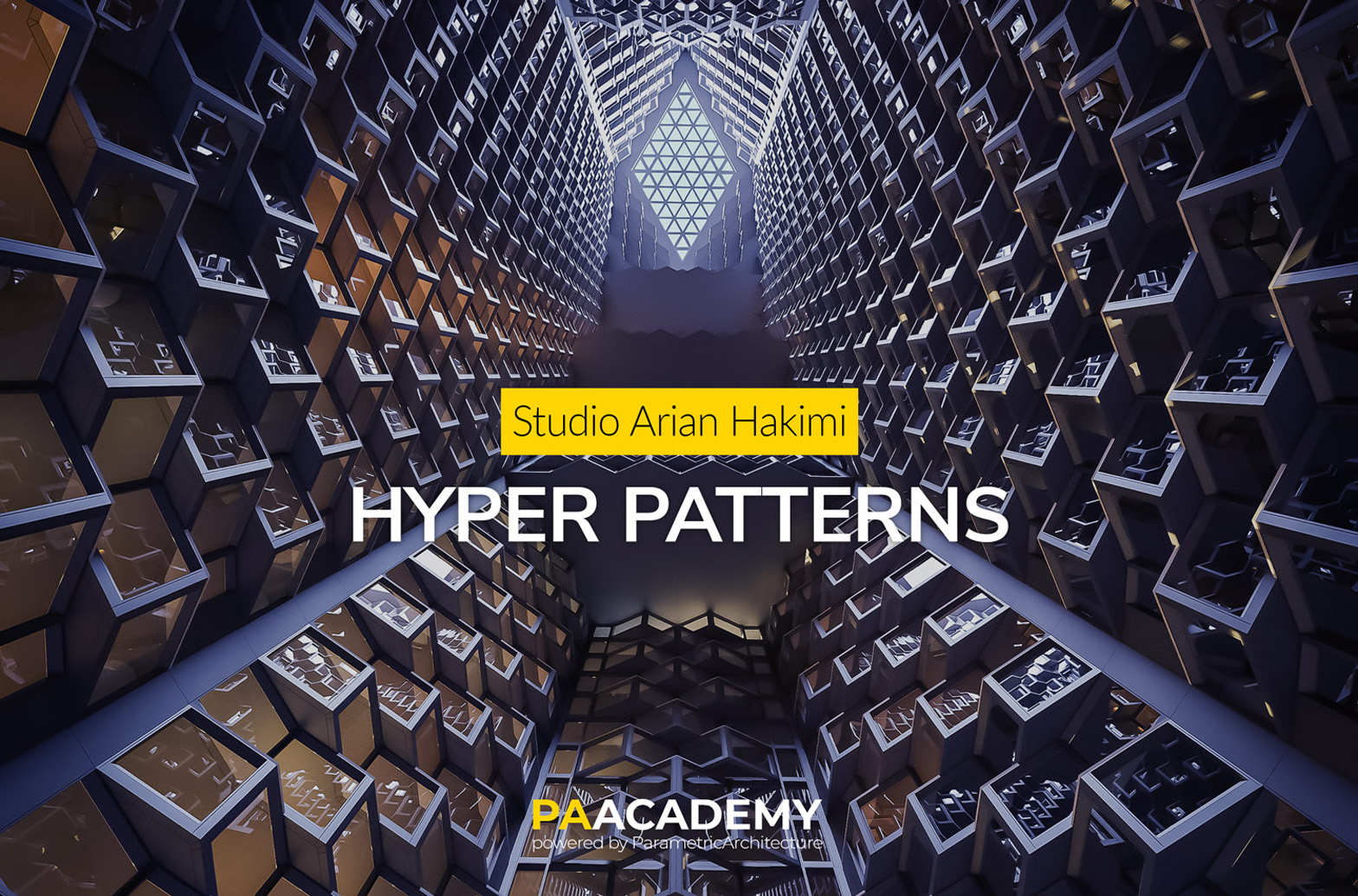
View hyper-patterns
Hyper Patterns studio
The Hyper Patterns design studio offers a fusion of academic knowledge and professional experience. Each applicant’s contribution to the final project will vary to reflect their own individual background and interests. Due to the intense nature and task deliverables, participants will work in groups. Each design phase will manifest itself in the meticulous production of digital model series of matrix-based catalogs. As for the final project, the design studies will be materialized in tower typology research.
Our future is set to be urban. As we move forward in the 21st century, the global population will likely continue growing. Today, more than half of the population [4.4 billion inhabitants] live in urban areas, and 1.5 million people are added to the global urban population every week. “70% of the world population projected to live in urban areas by 2050” UN Department of economic and social affairs. The next golden age of skyscrapers is upon us; between 1924 and 1934, 49 buildings over 150m in height were completed, all in the US. Between 2006 and 2016, there will be a total of 2296, with new towers on every continent.
Design Prologue
Pattern, by definition, means series/sequences that repeat. It can be represented as visible regularities in nature within a form of geometric shapes such as symmetry, fractals, spirals, bubbles, tessellations and …
From galaxy formation to an atomic orbital, almost every phenomenon in our cosmos is governed by rules that can be described as patterns in physical form. For over millennia, mankind has been attempting to explain the order in the universe, using mathematics seeking to discover and explain abstract behaviors in nature. This year, the Hyper Patterns program aims to re-define our basic understanding of patterns, re-discovering possibilities and expanding the rational capacity of complex geometries for the next generation of hyper building clusters in a multi-scenario multi-objective environment.
Design methodology
The form-finding mechanism is based on a rigorous and morphological process (to describe a scientific approach) constituted by 4 interconnected phases of exploration:
Component Study[CS]
Each group will select from a range of pre-rationalized components corresponding to the final project scenario. They will dichotomize by the inherent spatial characteristics of the component. Through sets of experiments by manipulating and variating each of the defining geometrical parameters, students become familiar with the geometrical logic and document their findings in a matrix-based catalog.
Objectives:
Humanizing architecture by reintroducing the human body as a measure of dimension and proportion
Define a set of individual units that could be expressed within larger interconnected parts
The geometric relationship between dimensions
Growth System[GS]
Recognizing and understanding the relationship between components within a controlled aggregation system, investigating the most compact and efficient assembly of components that can lead to a conceptual framework [formal-organizational possibilities Subsystem]
Objectives
Develop a problem-solving pattern cluster language (formal-organizational possibilities) (Subsystem correlation)
Experiments in optimizing the use of space in 2d and 3d
Program Each group will set out their experimental design strategy based on their self-defined program brief corresponding to the selected scenario. This process also includes the narrative, a source of inspiration that can justify the objective of the final project.
Design Development/Documentation
Consolidating the design repertoire into formal strategy and methodology concerning site/brief condition without losing its structural unity secures an intrinsic, three-dimensional expression in spatial form or building mass that would reflect spatial design organization.
Tutors: Arian Hakimi, Hoda Eskandarnia, Nariman Nejati
Organized by Parametric Architecture Academy [PAACADEMY]